


Are Air Purifiers Worth It?
Air purifiers are often recommended as a way to improve indoor air quality, but whether they’re actually worth it depends on how your home functions and what problems you’re trying to solve.
For some homeowners, an air purifier can noticeably reduce dust, allergens, and airborne particles. For others, it may not make much of a difference—especially if the underlying issue is related to airflow, moisture, or something the purifier isn’t designed to address.
The challenge is that air purifiers are often seen as a simple fix, when in reality they are just one part of a larger system. Understanding when they help—and when they don’t—is what makes them worth it.
This guide breaks down when air purifiers make a difference, when they don’t, and how to decide if one is a good fit for your home.
Home, Done Right – Perspective
Air purifiers can improve air quality—but they don’t solve every problem.
They work by filtering particles from the air, which can reduce dust, allergens, and other airborne debris over time. But they don’t bring in fresh air, and they don’t address moisture or airflow issues. That means whether they’re worth it depends less on the device itself and more on your home.
If your air quality issues are particle-based, a purifier can help. If the issue is something else, it may not make much of a difference.
The key is understanding what problem you’re trying to solve before deciding if a purifier is the right solution.
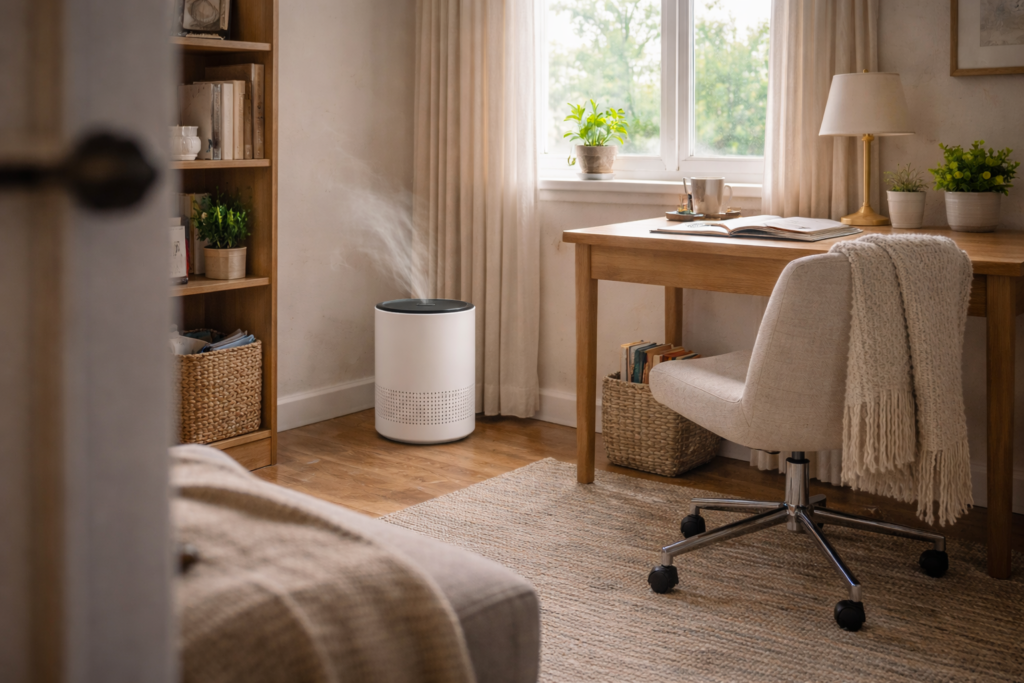
When Air Purifiers Are Worth It
Air purifiers are most useful when the main issue is airborne particles.
If your home has ongoing sources of dust, allergens, or fine debris, a purifier can help reduce how much of that material stays in the air over time.
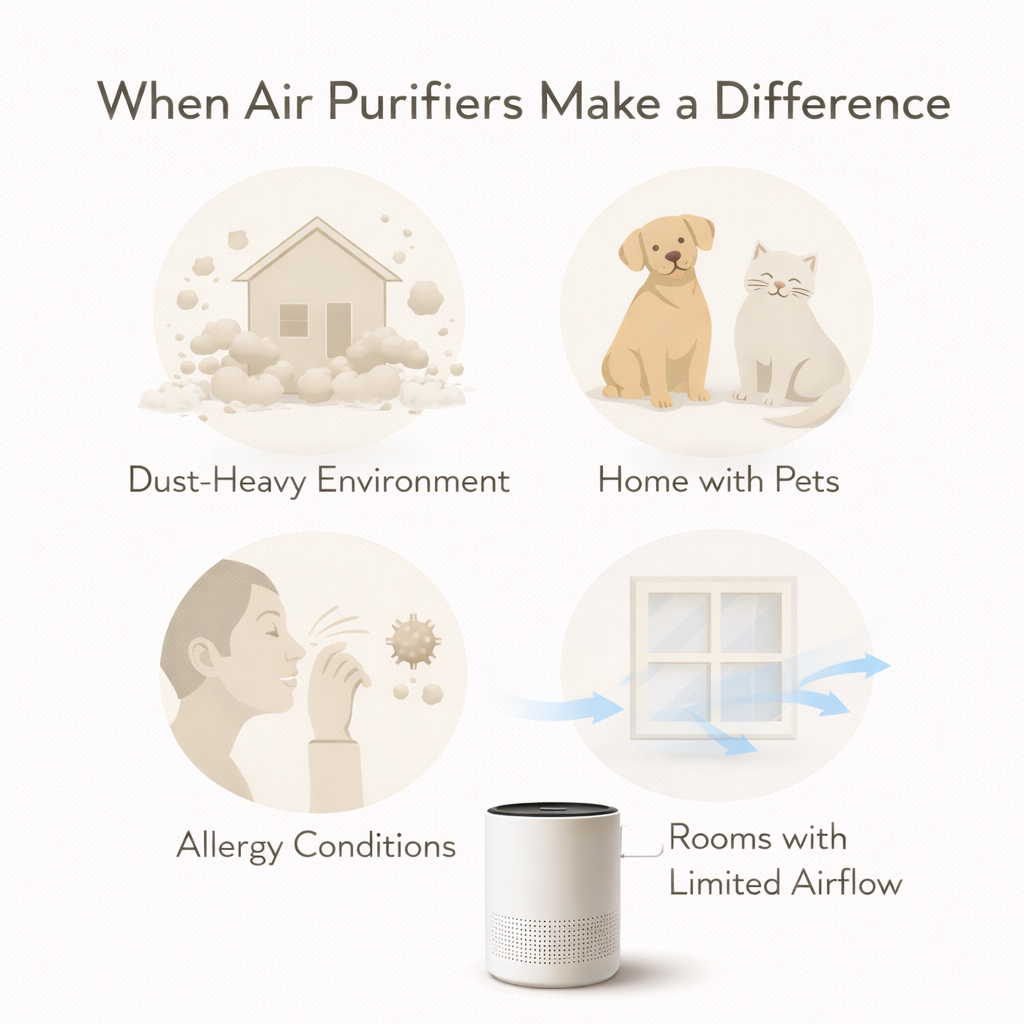
They Help Most When You Have:
- Frequent dust buildup on surfaces
- Allergens like pollen or pet dander
- Pets that shed regularly
- Rooms that feel stuffy but still have airflow
- Ongoing airborne particles from everyday activity
In these situations, an air purifier can make a noticeable difference by continuously filtering the air.
Why They Work in These Cases
Air purifiers are designed to capture particles that stay suspended in the air. When those particles are present consistently, the purifier:
- pulls them in
- traps them in filters
- reduces how much recirculates
Over time, this leads to:
- less airborne dust
- cleaner-feeling air
- fewer particles settling on surfaces
It helps to understand how air purifiers work before deciding if one is right for your home.
Learn More: How Air Purifiers Work

What to Expect
Even in ideal conditions, results are gradual. You may notice:
- dust building up more slowly
- fewer airborne particles in sunlight
- improved comfort in certain rooms
But the effect depends on:
- consistent use
- proper placement
- room size relative to the unit
If you’re dealing with ongoing dust, allergens, or pet dander, a well-sized air purifier can make a noticeable difference over time. Choosing a model that matches your room size and usage is what matters most.
While air purifiers can be helpful in the right situations, there are also cases where they won’t have much impact.
Learn More: Best Air Purifiers for Bedrooms
When Air Purifiers Are Not Worth It
Air purifiers don’t solve every type of air quality problem. If the issue isn’t related to airborne particles, a purifier may have little to no noticeable impact.
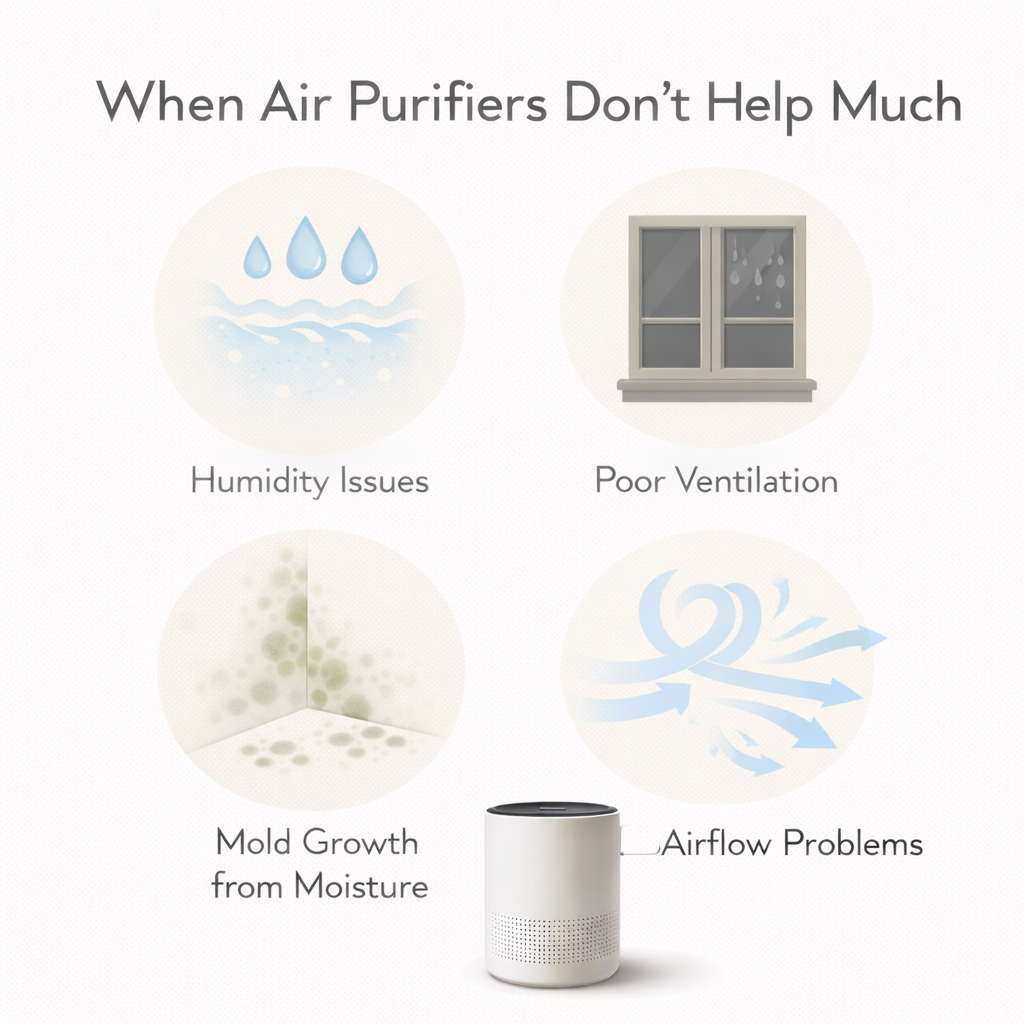
They Are Less Effective When You Have:
- High humidity or moisture problems
- Poor ventilation or stale air
- Mold caused by damp conditions
- Airflow issues between rooms
- Odors coming from a persistent source
In these cases, the underlying problem isn’t something a filter can remove.
Why They Don’t Help Much Here
Air purifiers:
- do not remove moisture
- do not improve airflow
- do not bring in fresh air
So if your issue is:
- humidity → needs moisture control
- stale air → needs ventilation
- uneven rooms → needs airflow balance
Learn More: How to Improve Indoor Air Quality at Home
Common Misalignment
One of the most common mistakes is using an air purifier to try to fix the wrong problem. For example:
- A humid basement → needs a dehumidifier
- A stuffy room → needs ventilation
- Condensation → needs airflow + moisture control
In these situations, a purifier may run continuously without making a meaningful difference.
What This Means for Your Decision
If your air quality issue is not particle-based, an air purifier is unlikely to be worth the investment on its own.
It may still have some benefit, but it won’t address the root cause.
To decide whether an air purifier is worth it, it helps to look at both the benefits and the trade-offs together.
Before purchasing an air purifier, it’s important to understand how it compares to a dehumidifier and which appliance is best for your specific needs. See our complete Air Purifier vs. Dehumidifier guide.
Cost vs Benefit: Is It Worth It for Your Home?
Whether an air purifier is worth it comes down to how much value it provides compared to its cost.
For some homes, the benefits clearly outweigh the cost. For others, the impact may be minimal.
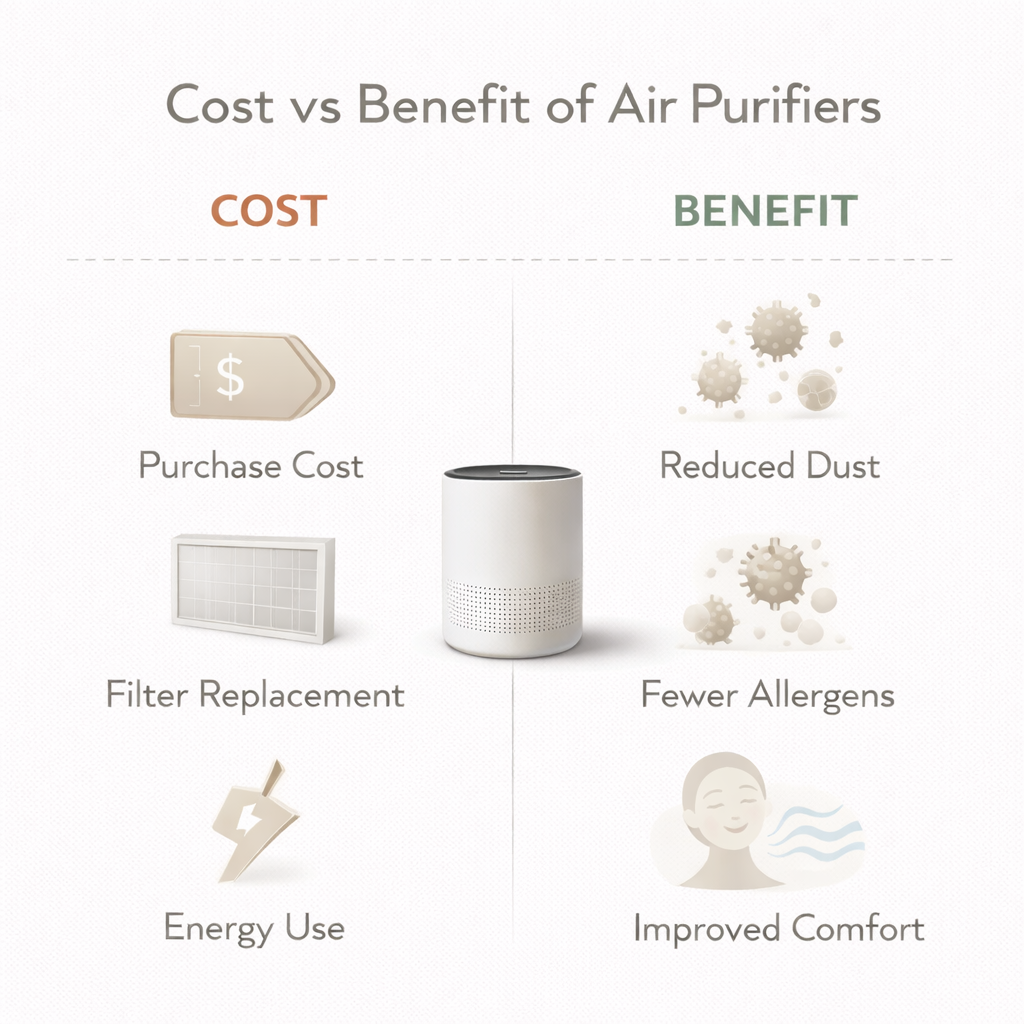
Typical Costs
Air purifiers involve both upfront and ongoing costs:
- Initial purchase of the unit
- Filter replacements over time
- Electricity use from continuous operation
These costs vary depending on the size of the unit and how often it’s used.
If you’re comparing options, it helps to look at models that balance filter quality, coverage area, and long-term filter costs.
Potential Benefits
When used in the right conditions, air purifiers can:
- Reduce airborne dust and particles
- Improve air comfort in certain rooms
- Help manage allergens like pollen or pet dander
- Support overall air quality when combined with good airflow
When the Cost Is Worth It
An air purifier is more likely to be worth it if:
- You have consistent airborne particles
- You want to improve a specific room (bedroom, office)
- You’re already managing airflow and humidity
- You plan to use it consistently
In these cases, the benefits tend to be noticeable over time.
When It May Not Be Worth It
It may be less worthwhile if:
- The main issue is humidity or moisture
- Airflow and ventilation are limited
- You expect immediate or dramatic results
- The unit is not sized correctly for the space
In these situations, the impact may be limited relative to the cost.
How to Think About It
Instead of asking “does it work,” it’s better to ask:
Does this solve the specific problem in my home?
If the answer is yes, the cost is often justified.
If not, addressing the underlying issue will provide more value.
Making the right decision comes down to understanding your home and how air quality problems show up in your space.
If you’re looking beyond portable units, you may also want to learn how air scrubbers work and how they compare to room air purifiers by reading our full guide on Air Purifier vs Air Scrubber, Which is Right for Your Home?
Conclusion
Air purifiers can be a useful addition to a home, but their value depends on what you’re trying to improve.
They are most effective when the issue is airborne particles like dust, allergens, or fine debris. In those cases, consistent use can gradually improve how the air feels and reduce buildup over time.
However, they don’t solve every air quality problem. Issues related to humidity, ventilation, or airflow need to be addressed separately for meaningful improvement.
Understanding the difference helps you decide whether an air purifier will actually make a difference in your home.
The Bottom Line
Air purifiers are worth it when they match the problem.
If your home has ongoing airborne particles, they can provide real, noticeable benefits over time. If the issue is something else, they may have limited impact.
The key is to focus on the cause of the problem first—then decide if a purifier is the right tool to help manage it.
If you’ve identified that an air purifier fits your situation, the next step is choosing the right one for your space.
Frequently Asked Questions
Are air purifiers actually worth it for most homes?
Air purifiers can be worth it if your home has ongoing airborne particles like dust, allergens, or pet dander. They are less impactful if the main issue is humidity, ventilation, or airflow.
Do air purifiers make a noticeable difference?
They can, but the results are usually gradual. Most homeowners notice slower dust buildup and improved air comfort over time rather than immediate changes.
Is it worth buying an air purifier for one room?
Yes. Air purifiers are often most effective when used in a single room, especially bedrooms or offices where you spend the most time.
Are air purifiers worth it for allergies?
They can help reduce airborne allergens like pollen, dust, and pet dander, which may improve comfort for some people. However, they are only one part of managing allergens in a home.
Do air purifiers help with dust?
Yes. They help reduce airborne dust by capturing particles before they settle. However, they don’t eliminate dust completely.
Are expensive air purifiers worth it?
Higher-priced models may offer better filtration or larger coverage areas, but value depends on whether the unit matches your room size and needs. A properly sized mid-range unit can often be effective.
Do air purifiers increase electricity bills?
They do use electricity, but most units are designed to run efficiently. The cost is usually modest compared to their overall usage.
What should you consider before buying an air purifier?
Consider the size of your room, the type of air quality issue you have, airflow in the space, and whether you’re willing to maintain the unit with regular filter changes.