
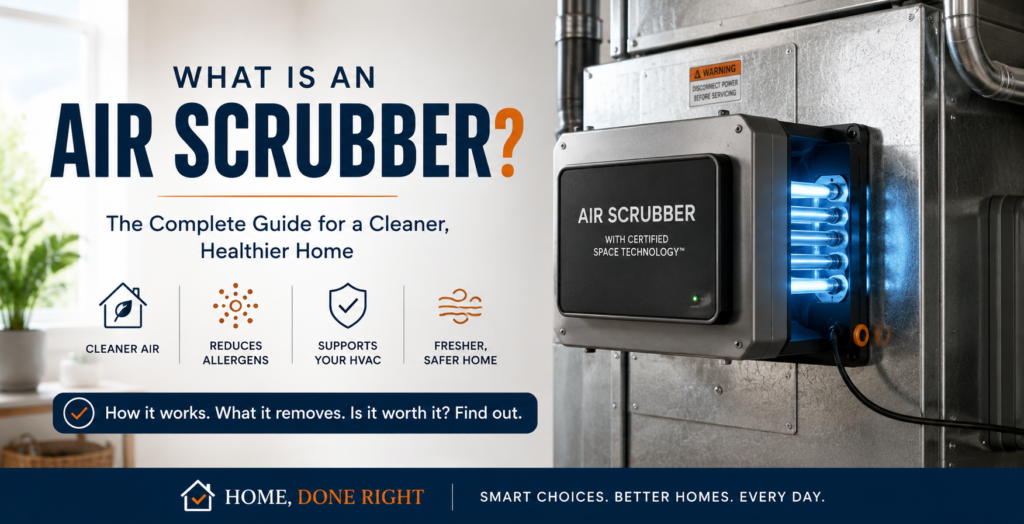
What Is an Air Scrubber? How It Works, Benefits, and Is It Worth It?
If you’ve been researching ways to improve your home’s indoor air quality, you’ve probably come across air scrubbers. These whole-home air purification systems are becoming increasingly popular, but many homeowners aren’t sure what they actually do or whether they’re worth the investment.
Unlike portable air purifiers that clean the air in a single room, an air scrubber is installed directly into your home’s HVAC system and works throughout the entire house. Depending on the technology used, air scrubbers are designed to reduce airborne contaminants such as dust, allergens, pet dander, odors, and other pollutants, helping create a cleaner and healthier indoor environment.
In this guide, we’ll explain what an air scrubber is, how it works, its potential benefits and limitations, how it compares to other air cleaning solutions, and whether it’s the right choice for your home.
Disclosure: This article may contain affiliate links. If you purchase through these links, we may earn a commission at no additional cost to you. This helps support Home Done Right and allows us to continue creating helpful homeowner resources.
Quick Answer
An air scrubber is a whole-home air purification system that installs directly into your HVAC ductwork. As air circulates through your heating and cooling system, the air scrubber helps reduce airborne contaminants such as dust, allergens, pet dander, odors, and other pollutants before the air is distributed throughout your home.
Unlike a portable air purifier, which only cleans the air in a single room, an air scrubber works throughout your entire house. While it isn’t necessary for every homeowner, it can be a worthwhile investment for those with allergies, pets, recurring odors, or concerns about indoor air quality.
Home, Done Right – Perspective
Air scrubbers can be an effective way to improve whole-home indoor air quality, but they’re not the right solution for every household. In our view, they make the most sense for homeowners who want continuous, whole-home air purification and are already investing in their HVAC system.
Before purchasing an air scrubber, it’s important to understand what it can and cannot do. While these systems can help reduce airborne contaminants and improve overall air quality, they aren’t a substitute for routine HVAC maintenance, quality air filters, proper ventilation, or addressing moisture problems. The best results come from using an air scrubber as part of a complete indoor air quality strategy rather than relying on it as a standalone solution.
What Is an Air Scrubber?
An air scrubber is a whole-home air purification device that is installed directly into your home’s HVAC system. Unlike a portable air purifier that cleans the air in a single room, an air scrubber works alongside your heating and cooling system to help improve the air quality throughout your entire home.
As your HVAC system circulates air through the ductwork, the air scrubber helps treat that air before it is redistributed into each room. Depending on the technology used, air scrubbers may help reduce airborne particles, allergens, pet dander, odors, and certain other indoor pollutants.
One important distinction is that air scrubbers are considered active air cleaning systems. Traditional HVAC filters and many portable air purifiers primarily remove contaminants as air passes through them. Some air scrubbers use additional technologies—such as UV light, ionization, or other purification methods—to actively help reduce contaminants within the HVAC system and circulating air.
Because different manufacturers use different technologies, the performance and capabilities of air scrubbers can vary. That’s why it’s important to understand exactly how a particular system works before deciding if it’s the right investment for your home.

How Does an Air Scrubber Work?
An air scrubber works by integrating directly with your home’s HVAC system. Every time your heating or air conditioning runs, air is pulled through the return ducts, passes by the air scrubber, and is then circulated back throughout your home.
While the exact process depends on the manufacturer and technology used, most whole-home air scrubbers are designed to help reduce airborne contaminants as air moves through the HVAC system. Some models use ultraviolet (UV) light, while others incorporate ionization or proprietary purification technologies to help reduce particles, odors, and certain microorganisms.
Unlike portable air purifiers that only treat the air in a single room, an air scrubber continuously treats the air circulating throughout your entire home. This makes it a convenient “set it and forget it” solution since it operates automatically whenever your HVAC system is running.
It’s important to understand that an air scrubber is only one component of a healthy indoor air strategy. Its effectiveness depends on factors such as your HVAC system, the quality of your air filter, proper ventilation, regular maintenance, and addressing issues like excess humidity or water intrusion. For the best results, an air scrubber should be viewed as one part of a comprehensive approach to improving indoor air quality.
Air Scrubber vs. Air Purifier
Air scrubbers and air purifiers are both designed to improve indoor air quality, but they work in different ways and are intended for different applications. Understanding these differences can help you choose the right solution for your home.

| Feature | Air Scrubber | Air Purifier |
|---|---|---|
| Installation | Installed inside your HVAC system | Portable, plugs into a standard outlet |
| Coverage | Whole-home air purification | Single room or designated area |
| Operation | Runs whenever the HVAC system operates | Operates independently |
| Best For | Whole-home air quality improvement | Targeted air cleaning in specific rooms |
| Initial Cost | Higher | Lower |
| Professional Installation | Usually required | No |
Choose an Air Scrubber If…
An air scrubber is a good option if you want continuous, whole-home air purification and are already upgrading or replacing your HVAC system. Because it works with your existing ductwork, it can help improve air quality throughout your home without requiring multiple portable units.
Choose an Air Purifier If…
A portable air purifier is often the better choice if you want to improve air quality in one specific room, such as a bedroom, nursery, or home office. It’s also a more affordable option for homeowners who aren’t ready to invest in a whole-home system.
Which One Is Better?
Neither option is universally better, they simply serve different needs. If your goal is whole-home air purification and you’re comfortable with the higher upfront cost, an air scrubber may be the better investment. If you’re looking for a cost-effective solution for a single room, a portable air purifier is often the more practical choice.
For some homeowners, the best solution is using both. An air scrubber can improve air quality throughout the home, while a portable air purifier provides additional filtration in rooms where you spend the most time.
To better understand how portable air purifiers work and whether they’re the right choice for your home, read our full guides on comparing Air purifiers vs. Air scrubbers to learn the differences in coverage, cost, installation, and maintenance. You can also review our information on How Air Purifiers Work and Air Purifier vs. Dehumidifier: Which One Does Your Home Need?
Air Scrubber vs. HVAC Filter
It’s a common misconception that installing an air scrubber means you no longer need an HVAC filter. In reality, these two components serve different purposes and are designed to work together—not replace one another.
An HVAC filter is your first line of defense. As air passes through your heating and cooling system, the filter captures dust, dirt, lint, pet hair, and other larger airborne particles. This helps protect your HVAC equipment while also improving indoor air quality.
An air scrubber provides an additional layer of air purification. Depending on the technology used, it is designed to help reduce airborne contaminants, odors, and other pollutants that may not be addressed by your HVAC filter alone.

| Feature | HVAC Filter | Air Scrubber |
|---|---|---|
| Primary Purpose | Protects the HVAC system and captures airborne particles | Provides additional whole-home air purification |
| Installation | Standard HVAC filter slot | Installed inside HVAC ductwork |
| Maintenance | Replace regularly | Periodic inspection and maintenance |
| Professional Installation | No | Usually required |
| Can Replace the Other? | ❌ No | ❌ No |
For the healthiest indoor environment, both components should be used together. A quality HVAC filter captures larger particles before they circulate through your system, while an air scrubber provides an additional level of air treatment throughout your home.
If your HVAC filter is dirty or overdue for replacement, even the best air scrubber won’t perform as effectively. Regular filter changes remain one of the simplest and most important steps you can take to maintain healthy indoor air quality.
Want to learn more about choosing and replacing HVAC filters? Read our complete guide on How Often Should You Change Your HVAC Filter?
What Can an Air Scrubber Remove?
While the exact performance varies by manufacturer and technology, many air scrubbers are designed to help reduce a wide range of airborne contaminants that affect indoor air quality. They work continuously whenever your HVAC system is operating, helping treat the air as it circulates throughout your home.
Depending on the model, an air scrubber may help reduce:
- Dust and fine airborne particles
- Pollen and seasonal allergens
- Pet dander
- Certain odors from cooking, pets, and everyday living
- Smoke particles
- Mold spores circulating through the air
- Some bacteria and viruses, depending on the technology used
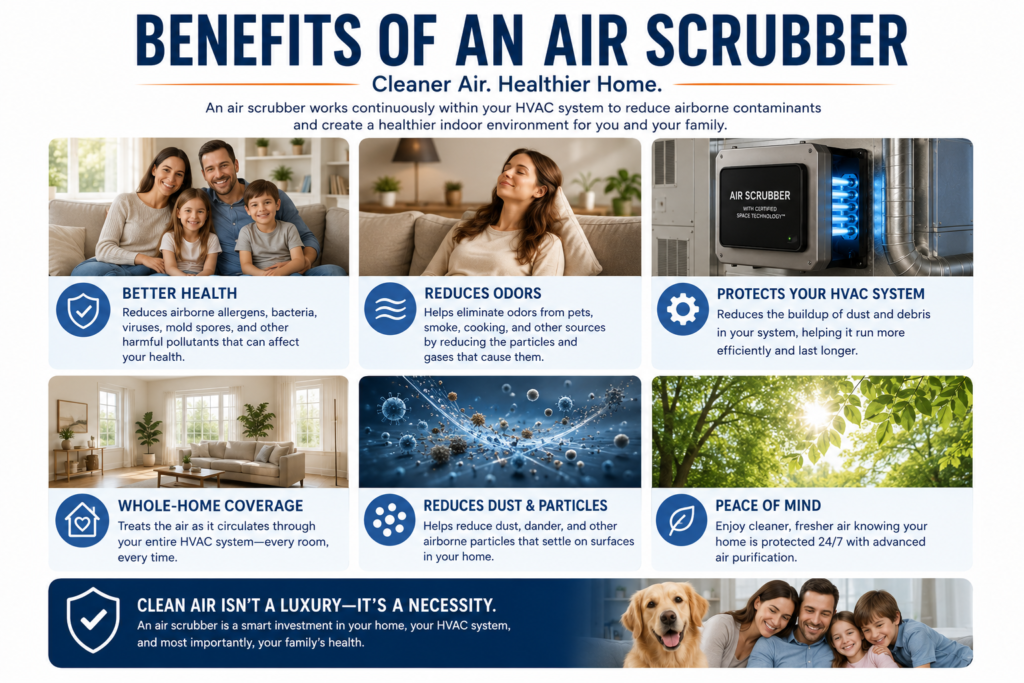
It’s important to understand that an air scrubber is not a cure-all. It cannot eliminate the source of indoor air quality problems, such as water leaks, mold growing inside walls, poor ventilation, or excessive humidity. Addressing these underlying issues remains essential for maintaining a healthy home.
When combined with a quality HVAC filter, regular maintenance, proper ventilation, and moisture control, an air scrubber can become one part of a comprehensive indoor air quality strategy.
For more ways to create a healthier indoor environment, explore our guide on How to Improve Indoor Air Quality.
Do Air Scrubbers Really Work?
Yes, air scrubbers can be an effective way to improve indoor air quality when they are properly installed and used as part of a well-maintained HVAC system. However, it’s important to have realistic expectations about what they can and cannot do.
Air scrubbers are designed to help reduce airborne contaminants as air circulates through your home’s HVAC system. Many homeowners report improvements in dust, odors, and overall air freshness, particularly when the system is paired with a quality HVAC filter and regular HVAC maintenance.
That said, no air cleaning device can solve every indoor air quality problem. An air scrubber cannot repair water leaks, eliminate mold growing inside walls, fix poor ventilation, or replace routine HVAC maintenance. It should be viewed as one component of a broader strategy that includes proper filtration, humidity control, ventilation, and keeping your HVAC system in good working condition.
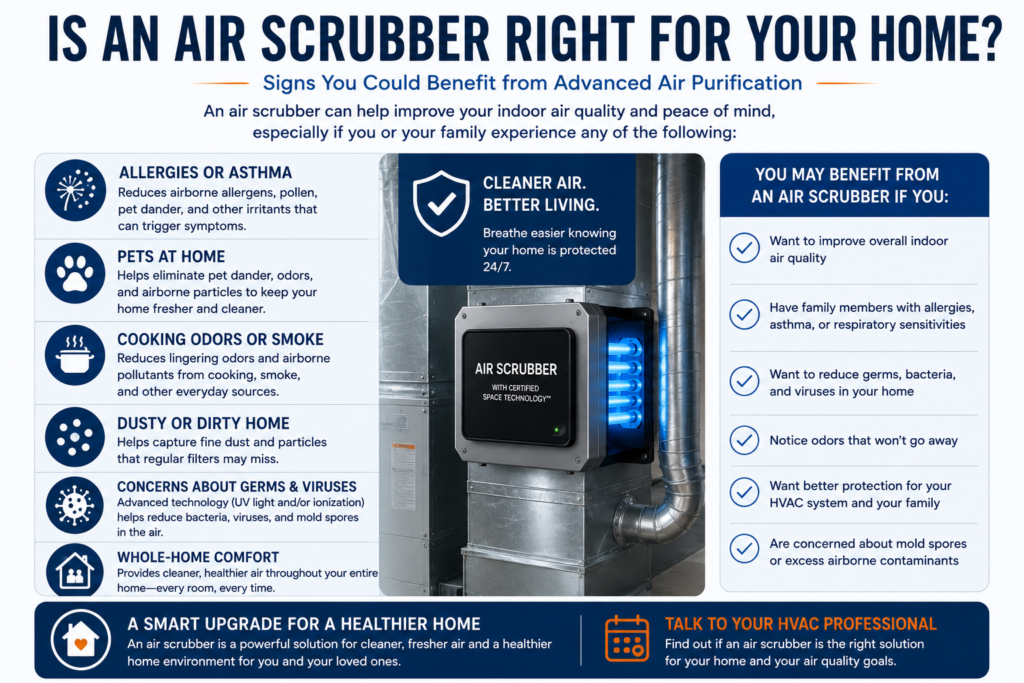
The effectiveness of an air scrubber also depends on factors such as the specific technology used, the size of your home, how often your HVAC system runs, and the overall condition of your ductwork. Because different manufacturers use different purification technologies, performance can vary from one model to another.
For homeowners looking to improve whole-home indoor air quality, an air scrubber can be a worthwhile addition—but it’s most effective when combined with other good home maintenance and air quality practices.
Are Air Scrubbers Worth It?
Whether an air scrubber is worth the investment depends on your home’s specific indoor air quality needs. For some homeowners, the added cost provides meaningful benefits. For others, a high-quality HVAC filter or portable air purifier may be all that’s needed.
An air scrubber may be worth considering if you:
- Want whole-home air purification instead of treating individual rooms
- Have family members with allergies or asthma
- Own pets that produce dander and odors
- Notice lingering cooking or household odors
- Want to improve overall indoor air quality throughout your home
- Are already replacing or upgrading your HVAC system
On the other hand, an air scrubber may not be the best investment if you’re simply trying to improve air quality in one room or you’re looking for the lowest-cost solution. In those situations, a quality portable air purifier often provides excellent performance at a much lower upfront cost.
Like any home improvement, an air scrubber should be viewed as part of a complete indoor air quality strategy, not a standalone fix. Pairing it with regular HVAC maintenance, quality filters, proper ventilation, and moisture control will provide the greatest long-term benefits.
For homeowners who want cleaner air throughout their entire home and are comfortable with the higher initial investment, an air scrubber can be a worthwhile upgrade. The key is choosing the right system for your needs and having it professionally installed.
Is an Air Scrubber Right for Your Home?
An air scrubber can be an excellent investment for the right homeowner, but it’s not a necessity for everyone. Before purchasing one, consider your home’s indoor air quality challenges, your budget, and whether a whole-home solution fits your needs.
An Air Scrubber May Be Right for You If…
- You want whole-home air purification rather than room-by-room filtration.
- Someone in your household has allergies or asthma.
- You have pets that contribute to dander and odors.
- You notice lingering cooking, smoke, or household odors.
- You’re already upgrading or replacing your HVAC system.
- You want a low-maintenance solution that works automatically with your HVAC system.
You May Not Need an Air Scrubber If…
- Your indoor air quality concerns are limited to one room.
- A portable air purifier already meets your needs.
- Your primary problem is excess humidity rather than airborne contaminants.
- Your HVAC system is older and not ready for additional upgrades.
- Basic maintenance, such as replacing HVAC filters or improving ventilation, has not yet been addressed.
Our Recommendation
For homeowners looking for a whole-home approach to cleaner indoor air, an air scrubber can be a worthwhile addition to a properly maintained HVAC system. However, it should complement, not replace, good home maintenance practices like changing HVAC filters regularly, controlling indoor humidity, and addressing the source of air quality problems.
If you’re unsure whether an air scrubber is the best choice, start by identifying the specific issue you’re trying to solve. In many cases, improving filtration, ventilation, or humidity control may provide significant benefits before investing in additional air purification equipment.
Learn More About Indoor Air Quality
Improving indoor air quality often requires more than one solution. Explore these additional homeowner guides to learn about air purification, humidity control, HVAC maintenance, and other ways to create a cleaner, healthier home.
The more you understand your home’s air quality and HVAC system, the easier it becomes to create a cleaner, healthier, and more comfortable living environment.
The Bottom Line
Air scrubbers can be an effective way to improve whole-home indoor air quality, but they’re not a one-size-fits-all solution. They work best for homeowners who want continuous air purification throughout the entire house and are willing to invest in a professionally installed HVAC upgrade.
While an air scrubber can help reduce airborne contaminants and improve overall air quality, it should be viewed as one part of a complete indoor air quality strategy. Pairing it with a quality HVAC filter, regular system maintenance, proper ventilation, and moisture control will provide the best long-term results for a cleaner, healthier home.
Conclusion
An air scrubber can be a valuable addition to your home’s HVAC system if you’re looking for a whole-home approach to improving indoor air quality. By helping reduce airborne contaminants throughout your home, these systems offer benefits that go beyond what a portable air purifier can provide in a single room.
However, an air scrubber isn’t a replacement for the fundamentals of a healthy home. Regular HVAC maintenance, replacing air filters on schedule, controlling indoor humidity, improving ventilation, and addressing moisture problems remain the foundation of good indoor air quality.
If you’re considering an air scrubber, start by identifying the specific issues you’re trying to solve. Understanding your home’s needs will help you determine whether an air scrubber is the right investment or if another indoor air quality solution is a better fit. With the right combination of equipment and routine maintenance, you can enjoy cleaner air and a healthier, more comfortable home for years to come.
Frequently Asked Questions
What is an air scrubber?
An air scrubber is a whole-home air purification device that installs directly into your HVAC system. It helps improve indoor air quality by treating the air as it circulates throughout your home.
How is an air scrubber different from an air purifier?
An air scrubber is installed within your home’s HVAC system and treats the air throughout the entire house. A portable air purifier operates independently and cleans the air in a single room or designated area.
Do air scrubbers really work?
Yes, air scrubbers can help improve indoor air quality when properly installed and maintained. However, their effectiveness depends on the specific technology used, your HVAC system, filtration, ventilation, and humidity control.
Are air scrubbers worth the money?
For homeowners seeking whole-home air purification—especially those with allergies, pets, or persistent indoor air quality concerns—an air scrubber can be a worthwhile investment. Whether it’s worth the cost depends on your home’s specific needs and budget.
Can an air scrubber remove mold?
Air scrubbers may help reduce airborne mold spores circulating through your HVAC system, but they cannot eliminate mold growing inside walls, ceilings, or other building materials. Moisture problems must be corrected to prevent mold growth.
Can an air scrubber remove odors?
Many air scrubbers are designed to help reduce common household odors, including cooking smells, pet odors, and other airborne odors. Results vary depending on the technology used and the source of the odor.
Does an air scrubber replace an HVAC filter?
No. An air scrubber is designed to complement—not replace—a quality HVAC filter. Your HVAC filter remains essential for capturing larger airborne particles and protecting your heating and cooling system.
Do air scrubbers require maintenance?
Yes. While maintenance requirements vary by manufacturer, air scrubbers should be inspected periodically and serviced according to the manufacturer’s recommendations to ensure they continue operating effectively.
Can I install an air scrubber myself?
Most air scrubbers are designed to be installed by an HVAC professional because they integrate directly with your home’s heating and cooling system. Professional installation helps ensure the system operates safely and effectively.
Who should consider installing an air scrubber?
An air scrubber may be a good option for homeowners looking for whole-home air purification, particularly those with allergies, asthma, pets, or ongoing indoor air quality concerns. It can also be a valuable upgrade when replacing or improving an existing HVAC system.